
John 8:1-11
8 Jesus returned to the Mount of Olives, 2 but early the next morning he was back again at the Temple. A crowd soon gathered, and he sat down and taught them. 3 As he was speaking, the teachers of religious law and the Pharisees brought a woman who had been caught in the act of adultery. They put her in front of the crowd.
(click on picture to the right to hear the audio as well)
4 “Teacher,” they said to Jesus, “this woman was caught in the act of adultery. 5 The law of Moses says to stone her. What do you say? 6 They were trying to trap him into saying something they could use against him, but Jesus stooped down and wrote in the dust with his finger. 7 They kept demanding an answer, so he stood up again and said, “All right, but let the one who has never sinned throw the first stone!” 8 Then he stooped down again and wrote in the dust. 9 When the accusers heard this, they slipped away one by one, beginning with the oldest, until only Jesus was left in the middle of the crowd with the woman. 10 Then Jesus stood up again and said to the woman, “Where are your accusers? Didn’t even one of them condemn you?”
11 “No, Lord,” she said.
And Jesus said, “Neither do I. Go and sin no more.”
Click here to see the scene from the The Bible Mini Series
What a beautiful picture of Jesus’ gentleness.
By law the woman deserved to be stoned. He said to them, “whoever has never sinned throw the first stone!” Jesus could have thrown the first stone! He had never sinned.
According to Jewish law she deserved to be condemned. She deserved to be destroyed. She deserved to be punished. The people watching Jesus knew that. Instead of the woman experiencing the wrath of God and being punished for her sin – Jesus says, “Where are your accusers? Didn’t even one of them condemn you?” “Neither do I, Go and sin no more.”
Jesus didn’t come to condemn the world – he came to save it!
Jesus didn’t come to destroy life – he came to give life.
Jesus didn’t come to punish people – he came to give people purpose.
Because Jesus did these kind of things – He has been viewed as weak, soft, and spineless.
If we take an honest look at our heart, we want people to be punished for their sin. We say things like, “where’s a cop when we need them?” People deserve to be punished. They deserve to experience the wrath of God. We believe some kind of harm should happen to evil people. When something does happen we say, “they got what they deserved.”
But Jesus was strength under control. He was calm and peaceful when surrounded by a heated atmosphere. He had a soothing effect on those who got angry and other wise beside themselves. He possessed a tact and gracious courtesy that caused others to regain their confidence and dignity.
Let’s take a look at gentleness is not …..
Gentleness is never a false modesty, a self-depreciation, or a spineless refusal to stand for anything. Gentleness is never a cowardly retreat from reality, which substitutes a passive selfishness for real gentleness and avoids trouble in ways that allow even greater trouble to develop. Neither is it a false humility that refuses to recognize God has given us talents and abilities or that refuses to use them for His glory.
Gentleness is …..
A power under control that is used to impact and influence the lives of others.
Responding in a gentle way throws people off. When people get angry with you and you don’t get angry back they don’t know what to do. When someone does something to you and you don’t respond. They eventually stop.
I remember at a football game in Sidney, OH (where we lived for 17 years) – a guy was cussing left and right and calling the refs name that the ref couldn’t hear but my kids could hear.
I calmly turned around and asked him to stop because I didn’t think my kids needed to hear those words at their age. He went off on me. I responded in a calm way said, “sir, it is only a high school football game.” Then he went off on me again. He went on saying harsher things.
I didn’t move – I stayed there. I didn’t say another word to him. At the end of the game, he came up to me an apologized for his poor behavior and apologized to my kids for the words he used.
Proverbs 15:1 A gentle answer deflects anger,
but harsh words make tempers flare.
What if I would have responded with harsh words? If would have been a battle of wit and words I would have sliced and diced him. If it had been a battle of fist and fighting I would had been lying in the hospital. The gentle answer deflected his anger and produced an apology. We both grew up that night.
Aristotle (a really smart Greek philosopher) describes gentleness as, ”a halfway between excessive anger and indifference.” He felt the gentle person could be angry at the right time and submissive at the right time.
One historical figure that I admire because he demonstrated such gentleness during a trying time in our country history was Abraham Lincoln. Abe was known as “gentle Abe” and honest Abe.
He was calm and peaceful during one of the most trying times in America’s history. He had a soothing effect on people when they met him. He had a strength that was under control. He was viewed as soft, spineless, and weak. He wasn’t Jesus but he gives us a picture a man who used his power to impact and influence both the people of the north and the people of the south.
One historian called him “hard as rock and soft as the drifting fog.”
His personal secretary and subsequent biographer John Hay wrote of Lincoln, “One of the most tender and compassionate of men, he was forced to give orders that cost thousands of lives…the awful responsibility resting upon him as the protector of an imperiled republic kept him true to his duty, but could not make him unmindful of the intimate details of that vast sum of human misery involved in a civil war.”
He was especially famous for his pardons. “No man holding in his hands the key of life and death ever pardoned so many offenders, and so easily,” said Indiana Congressman Schuyler Colfax. He was so famous for pardons that one general claimed the only way to avoid a Lincoln pardon was to shoot the guy first.
How do you get gentleness?
1. Study the life of Jesus.
“Learn from Me, for I am gentle and humble in heart” (Matt.11:29).
What do we learn from Jesus in this story?
- Don’t crush the wounded.
This woman had been caught in the act of adultery and according to the law she deserved to be stoned. No one knows her background and there are number of reasons why women choose to be prostitutes. I am not going to pretend I know why she chose this lifestyle. I do know that women were treated as second class citizens. I do know that women were seen as objects. I am guessing she lost hope. I am guessing she lost respect for herself.
She was wounded. Jesus knew that. Jesus didn’t point out her sin. Jesus didn’t see her as a second class citizen. Jesus simply loved her and forgave her. He didn’t view her as a second class citizen He loved her. He didn’t view her as an object. He loved her. Jesus knew her story and he showed compassion and gave her hope. He loved her when no one else would love her. Jesus will never crush anyone.
Isaiah 42:3a
He will not crush the weakest reed or put out a flickering candle.
Every person you see has been wounded. They have been wounded either physically, emotionally, or psychologically. All of us in here have been wounded. Every person has a story if we would just sit down and listen to it. Some of us have been crushed and we’ve gone to God and asked, “why?” There is a reason we act the way we do. It would explain who they are and why they are the way they are. We all have flaws and fall short of the glory of God.
There was a beautiful example of gentleness this past week in Atlanta, Georgia. If you watch CNN you are probably familiar with the story. Antoinette Tuff saved 500 elementary students lives by her gentleness with a man who came in with 500 rounds of ammunition. Listen to what she says to this would be killer (just click on the pick)

Do you here the gentleness in her voice? She said, “Baby, we ain’t going to hate you. We are going love you. You are doing the right thing by giving up. ” In the conversation she treated him with dignity and respect.
2. Practice it – Be a living example
In Ephesians 4:2 Paul is urging us to live a life worthy of the calling we have received, he calls on us to be “completely humble and gentle.” We are to be free from self-exaltation and fully submitted to the will of God both in our relation to Him and in our relationships with others.
Take a day and don’t talk about yourself. Look to the interest of others. Be a living example.
In Colossians 3:12, Paul urges us “as God’s chosen people, holy and dearly loved,” to clothe ourselves “with compassion, kindness, humility, gentleness, and patience.” This shows that the fruit of the Spirit needs our cooperation for its development.
Take a day and put on gentleness.
- Be gentle in your responses to people. Especially in times of conflict.
- Be gentle in your actions towards people.
- Be gentle with your kids when they mess up.
- Be gentle with your spouse when they aren’t acting the way you want to them to act or do what you want them to do.
In 2 Timothy 2:25, Paul tells the Lord’s servant that those who oppose him he must gently instruct, in the hope that God will give them a change of heart, leading them to the knowledge of the truth. Gently instruct others. You can’t change the way people think but our gentleness (gentle response, gentle words) gives God a chance to change their heart. Leading them to truth.
In Titus 3:2, Paul instructs Titus to be ready to do whatever is good, to slander no one, to be peaceable (that is, not quarrelsome), to be considerate, and to show true humble gentleness toward everyone. It includes the idea of springing to the help of those in need, yet keeping our own feelings under control.
- Be ready to do good.
- Don’t slander anyone.
- Be peaceable (don’t create quarrels)
- Be gentle towards everyone.
Finally, in 1 Peter 3:15,16, we are told to be prepared to answer everyone who asks us to give the reason for the hope we have. But we are to do this “with gentleness and respect.”
We can’t manufacture gentleness. It is something that has to be learned and practiced. We need to be taught how to be gentle. Every frustration. Every impatient moment. Every conflict you experience is an opportunity to practice gentleness.
When are gentle with others it gives God the opportunity to change their heart.
God needs gentle people.

James 5:7-10
7 Dear brothers and sisters, be patient as you wait for the Lord’s return. Consider the farmers who patiently wait for the rains in the fall and in the spring. They eagerly look for the valuable harvest to ripen. 8 You, too, must be patient. Take courage, for the coming of the Lord is near.
9 Don’t grumble about each other, brothers and sisters, or you will be judged. For look—the Judge is standing at the door!
10 For examples of patience in suffering, dear brothers and sisters, look at the prophets who spoke in the name of the Lord. 11 We give great honor to those who endure under suffering. For instance, you know about Job, a man of great endurance. You can see how the Lord was kind to him at the end, for the Lord is full of tenderness and mercy.
There is a story about the Pope who was on a visit to America for a period of time. On his last day of the visit, he was delayed due to meetings and was unable to break away to catch a flight.
Since he couldn’t depend on his Pope Mobile, he phoned for a limousine. When the limousine arrived, the driver was joyfully surprised that it was the Pope who called for him. The driver became nervous and was beside himself. He proceeded to drive very slowly. The Pope became nervous and told him to hurry up. It did not make a bit of difference. The driver went slower; he wanted to keep the Pope in his limousine as long as he could. The Pope could not be delayed any longer so he asked to drive the limo himself. The Pope sped off and reached the speed of 85 miles an hour. The policeman who stopped him was shocked when he discovered the famous personality behind the wheel. He frantically phoned his police chief and said, “Chief, I have stopped a very important figure for speeding. I don’t know what to do?”
–“What do you mean? Give him a speeding ticket!”
–“Sir, in all honesty, I can’t.”
–“Why can’t you? The law is the law. Who is it anyway that you stopped? Is it the mayor?”
–“No, sir.”
–“Is it the governor?”
–“No, sir.”
–“Is it a congressman?”
–“Is it the president?”
–“No, sir.”
–“Well, then, who is it?!”
–“I don’t know sir! All I know is that the Pope is driving him to the airport.”
Even the Pope gets impatient.
When everything is going our way, patience is easy to demonstrate. The true test of patience comes when our rights are violated—when another car cuts us off in traffic; when we are treated unfairly; when our coworker derides our faith, again. When our kids aren’t acting the way we want them to. When our spouse doesn’t do what we asked them to. When we are in a hurry because we failed to plan. In these situations it is a lot more difficult to be patient because we think we have a right to get upset in the face of irritations and trials.
These situations are really opportunities for us to exercise patience.
Take a look at this 30 second clip on patience
God doesn’t give us patience. He gives us the opportunity to be patient. God wants to produce patience in us.
Patience is not a passive waiting or a gentle tolerance. Just because someone is passive does not mean they are patient. Just because someone tolerates something gently does not mean they are patient.
Patience is a willful decision to suffer joyfully while the other person seemingly gets their way.
- You still love them.
- You let them get their way
- You surrender your rights to be right.
- You give up control.
Didn’t Jesus make a willful decision to suffer joyfully while those around him seemingly got their way? He still loved them because he said, “father forgive them they know not what they do.” He let them get their way. He didn’t say anything when he was on trial. Jesus surrendered himself. He was right and he did nothing wrong but they killed him anyway. Jesus gave up control of His life, His situation, and put his confidence in the promises of His Father.
The farmers and the prophets that James mentions in this passage do the same thing.
- When a farmer puts the seed in the ground he doesn’t know if it is going to get enough rain to make it grow.
- The OT prophet endured a lot of suffering speaking the name of the Lord in a culture that rejecting them and the message.
God wants to do the same in us. Why?
Because our impatience with people can destroy people’s lives.
- Our impatience with our kids can destroy their life
- Our impatience with our spouse can destroy their life
- Our impatience with those around us can destroy their life.
Our impatience with God can destroy our lives.
How do you get patience?
1. Think on how patient God is
2 Peter 3:9
9 The Lord isn’t really being slow about his promise, as some people think. No, he is being patient for your sake. He does not want anyone to be destroyed, but wants everyone to repent.
He is patient for our sake. He does not want to destroy anyone. He wants everyone to repent.
Look at His patience with Israel throughout the OT. They constantly rebelled. He took them back. They rebelled. He took them back again. They rebelled again he took them back again. Look at his patience with Adam and Eve, Abraham, Moses, and the countless others who have failed. Look at His patience with you and me.
We learn about his patience for us through other people. As the scripture points out we need examples. Think of all the people who have been patient with you over the years. Those people who were willing to give you a chance. Allow you to make mistakes. They endured or suffered joyfully, while you matured and grew up.
My wife is that person for me. She is not perfect by any means. She is perfect for me. Our first few years of marriage were not very pleasant for my wife. The one nice word that would describe me in those few years was a total butthead. Most first time husbands don’t really get what being a husband is about. I know I didn’t. God instructs men that they must leave their parents and cleave to their wife. If you noticed God didn’t have to say anything about the woman leaving and cleaving. They seem to get it quicker. There was one particular year that was really dark for me. A year I wouldn’t want to relive. In the ministry world they call it the “dark night” for the soul. My wife was patient. She suffered joyfully. She endured as I sought counsel and probably praying “when is this guy ever going to change?”
Another great picture of patience was my dad. As a kid, I got to share him with 3-400 other kids in the community. My dad “suffered joyfully”. I watched other kids hit him. I watch other kids spit on him. I listened while some kids called him names that I can’t repeat. How do I know he suffered joyfully? He kept going back day after day. Giving hope to kids who didn’t have dads.
For me these were beautiful pictures of God’s patience with me.
Think about someone who has been patient (suffered joyfully) with you. Then “pay it forward” to your kids, “pay it forward” to your spouse,” pay it forward” to the person who cuts you off. “Pay it forward” to those annoying people in your life. At one point in your life you were annoying. You were childish, you were thinking only of yourself.
2. Endure under suffering
Read the book of Job. He lost his family, his wealth, and his health and not once did he curse God. Not once did he turn his back on God. He endured. Why did he endure?
Because had confidence that God was in control. Look at what he says in vs. 21 (Job 1)
21 He said,
“I came naked from my mother’s womb,
and I will be naked when I leave.
The Lord gave me what I had,
and the Lord has taken it away.
Praise the name of the Lord!”
Despite his suffering. Despite having lost everything. He stayed around until the end of the story. He didn’t give up on God and his relationship him. Because he had confidence that God was in control, Job was patient with his bitter wife and his wonderful friends who tried to convince him that he had done something to deserve all this he was going through.
The book of Job is the text-book of how to endure suffering.
3. Ask for it
Then wait. Patience does not develop overnight (remember last week – there is nothing good about us. We are all flawed.)
The opportunities will come.
- The next time someone cuts you off – thank God for them
- The next you are betrayed by a friend or family – pray for them
- The next time someone makes fun of you – remember that you belong to God.
The work of the Holy Spirit and God’s goodness are crucial to the development of patience.
- Let God change the way you think.
- Let God change you!
- Let’s stop blaming our impatience on everyone and everything else. It’s not their fault. The impatience was already inside of you. The irritable situation just brought out what was already there.
- Adam blamed Eve and God
- Eve blamed the serpent
- We blame others for what was already inside of us.
All of the things we walk through in life are an opportunity for God to do the amazing in our life.
Look at what the scriptures continue to say:
Colossians 1:11 tells us that we are strengthened by Him to “great endurance and patience,”
James 1:3-4 encourages us to know that trials are His way of perfecting our patience.
Our patience is further developed and strengthened by resting in God’s perfect will and timing, even in the face of evil men who “succeed in their ways, when they carry out their wicked schemes” (Psalm 37:7).
Our patience is rewarded in the end “because the Lord’s coming is near” (James 5:7-8).
“The Lord is good to those whose hope is in him, to the one who seeks him” (Lamentations 3:25).
Put your confidence in the one who invented patience and allow Him to finish this part of your story.

Titus 3:8 New Living Translation (NLT)
8 This is a trustworthy saying, and I want you to insist on these teachings so that all who trust in God will devote themselves to doing good. These teachings are good and beneficial for everyone.
Corrie Ten Boom wrote:
Often I have heard people say, “How good God is! We prayed that it would not rain for our church picnic, and look at the lovely weather!'” Yes, God is good when He sends good weather. But God was also good when He allowed my sister, Betsie, to starve to death before my eyes in a German concentration camp. I remember one occasion when I was very discouraged there. Everything around us was dark, and there was darkness in my heart. I remember telling Betsie that I thought God had forgotten us. “No, Corrie,” said Betsie, “He has not forgotten us. Remember His Word: ‘For as the heavens are high above the earth, so great is His steadfast love toward those who fear Him.'” Corrie concludes, “There is an ocean of God’s love available–there is plenty for everyone. May God grant you never to doubt that victorious love–whatever the circumstances.”
Only God is good. Even in the worst of circumstances God is good.
Jesus said it himself in Luke 18:19 19 “Why do you call me
good?” Jesus asked him. “Only
God is truly good.”
and Psalm16:2
2 I said to the Lord, “You are my Master!
Every good thing I have comes from you.”
If you read the scriptures from Genesis to Revelation you would discover that His goodness never changes.
His goodness is not changed by our circumstances.
His goodness is not changed by what we are feeling.
His goodness is not based on how faithful or unfaithful we are.
His goodness is not based on how obedient or disobedient we are.
God is always good. He is not going to change.
We are the ones who change!
Let’s go back to Understanding the Bible 101: If you remember God is not the one who took the bite of the fruit in the Garden of Eden; nor did He TELL them to eat the forbidden fruit. God did not bring sin, disease, war, and selfishness
into the world nor did the Enemy! Mankind did! We blame the Enemy (The devil) but He didn’t bring evil into the world. Mankind did!
I read a quote the other day that said, “as long as there are humans there will be evil in the world.” So the enemy doesn’t cause evil to happen nor does God cause evil to happen. Evil happens because there are humans.
If you look at the scriptures – there is nothing good about us.
Ephesians 2:3 – We started out bad being born with evil natures …….
Romans 3: 10-12 There is none righteous, not even one; there is none who understands, there is none who seeks for God; all have turned aside, together they have become useless. There is not who does good, there is not even one.
We start out selfish, self-centered, self-absorbed. None of us here is born naturally good! There are people who do good but we are talking about people who are born good. Scriptures teach us that none of us have a natural inclination of pure goodness. All of us are flawed.
Look at children. Don’t we have to teach them what is right and wrong and what is good and bad? We don’t have a natural inclination for goodness.
We are born separated from God. We all are born with a selfish nature. We are born into this world with one enemy: God.
Psalm 14:1, Psalm 53:1, remind us there is no one who does good.
We battle with Him until we humble ourselves and finally surrender. This is why spiritually we must be born again (John 3).
Think about it. When we don’t get our way, what do we do? We throw tantrums. And when we get older with just throw adult tantrums. We just become more sophisticated at throwing tantrums. Children just let it rip. We adults sulk, complain, go silent, withdrawal, and make life horrible for those who are close to us.
Our goodness comes from being in a relationship with Him.
We, as God’s people, are not good in and of ourselves in the way God is. With God’s help we have the potential for doing good and being good through the empowerment of His Holy Spirit and the presence of God in our lives through Jesus Christ we can attain this attribute. In this way, we are able to reflect God’s goodness in our own lives and not just have it as the surface appearance that so many have.
Look at the story of the Rich man in Luke 18. He comes with a question, “Good teacher what should I do to inherit eternal life?” Jesus rattles off a few of the Ten Commandments. The rich man response was that he has kept those commandments since He was young. In other words, he did all the right things. On the surface he looked good but when Jesus said to put that righteous into action by selling everything he had and giving it to the poor. He walked away sad.
Most of us would say that a person that a person who keeps the Ten Commandments is a good person. The Pharisees kept the Ten Commandments. Judas kept the Ten Commandments. There are people who swear by the Ten Commandments. The Pharisee’s look good on the outside. But Jesus called them a brood of vipers and what washed tombs . Judas kept the Ten Commandments but he ended up betraying Jesus. The Rich man kept the Ten Commandments but he walked away sad.
All of these examples were good people – God wants to produce in us something more than just a surface appearance of good. We can do that. The devil can do that.
God wants to produce goodness in us. Not just good acts.
Most of us in here would call ourselves good people. We keep the Ten Commandments. We come to church. We give a tithe or a $20 tip to God. We feel good about ourselves. We help in a ministry. We pray for others. Some of us read our Bibles. Some of us do devotions. Some of us are even leaders. All of these are good things. We call our self, good, because of the good things we have done.
Isaiah 64:6 reminds us that “When we display our righteous deeds, they are nothing but filthy rags.”
God wants to produce in us an intense need to devote ourselves to doing good. Not just for show but allowing God to transform our:
- Selfishness into otherness
- Self-centeredness into other-centeredness
- Self- absorbentness into a living sacrifice
How does this transformation begin? (your part)
- Understand how good God has been to you. (think on things that are noble, right true, trustworthy). Romans 8
- Think of how good God has been to you and thank Him!!
- Put your confidence in the One who created goodness.
- Devote yourself to doing good.
Repeat these steps over and over and over and over and over and over again. This will bring God’s goodness to the core of your being. We need God’s goodness at the core of our being in order to reflect God’s goodness in our own lives and not just have it as the surface appearance that so many have.
Like the other Fruit of the Spirit we have talked about, we cannot manufacture goodness.
According to Webster’s New Universal Dictionary, “goodness” is a euphemism for ‘God’. In other words Goodness in the Bible is God himself.
Goodness is a Fruit of the Spirit that can only be produced by God.
Psalm 125:4
O Lord, do good to those who are good,
whose hearts are in tune with you.
This verse reveals a key element connected to goodness—being upright—or righteous in our hearts. Not just visibly but in our hearts and minds, at the very core of our being. This is the goodness that is missing in these individuals that only look good on the surface.
Goodness is energized excellence of character that manifests itself in active good. It is more often directed toward those who do not deserve benevolence.
In other words, it is enthusiastic action in doing the right thing. (active righteousness).
Like the other fruits we have talked about – there is a counterfeit goodness.
This past week I had lunch with a friend. An older couple started talking to us and they thought the other person with me was my son. The friend I was with is much more bolder than I have been in my faith. There in the middle of Wendy’s he said, “you must be a believer?” The older man fumbled around and said yes. And then proceeded to tell us that he was with God when he was weeding his garden, pulling weeds, doing anything outside. So he asked, “do you follow Jesus?” He responded that he didn’t need to because he was with Him all the time. The older woman was more honest. She said I am not sure. And then chastised her husband for lying to us about being believers.
This is what hypocrisy and spiritual phoniness look like:
1 John 4:20 ESV (English standard version)
If anyone says, “I love God,” and hates his brother, he is a liar; for he who does not love his brother whom he has seen cannot love God whom he has not seen.
James 1:26 ESV
If anyone thinks he is religious and does not bridle his tongue but deceives his heart, this person’s religion is worthless.
You hypocrite, first take the log out of your own eye, and then you will see clearly to take the speck out of your brother’s eye.
Matthew 6:1 ESV
“Beware of practicing your righteousness before other people in order to be seen by them, for then you will have no reward from your Father who is in heaven.
Matthew 15:7-9 ESV
You hypocrites! Well did Isaiah prophesy of you, when he said: “‘This people honors me with their lips, but their heart is far from me; in vain do they worship me, teaching as doctrines the commandments of men.’”
Romans 2:3 ESV
Do you suppose, O man—you who judge those
who practice such things and yet do them yourself—that you will escape the judgment of God?
1 John 2:9 ESV
Whoever says he is in the light and hates his brother is still in darkness.
There are 191 more verses that deal with this issue (it is a pretty big deal to God).
If you take a look at the Acts you will get a good picture of what goodness looks like. It wasn’t because of the good acts they were doing that were causing such a great stir and transforming the culture in which they lived. They did it with enthusiasm because they allowed God to replace their selfish, self-centered, self-absorbed hearts and minds with an intense need to devote themselves to doing good.
God is asking the same of us.

1 John 3:16-20
16 We know what real love is because Jesus gave up his life for us. So we also ought to give up our lives for our brothers and sisters. 17 If someone has enough money to live well and sees a brother or sister in need but shows no compassion—how can God’s love be in that person?
18 Dear children, let’s not merely say that we love each other; let us show the truth by our actions. 19 Our actions will show that we belong to the truth, so we will be confident when we stand before God. 20 Even if we feel guilty, God is greater than our feelings, and he knows everything.
John was admitted into the emergency room and placed on the cardiac floor. He was unshaven, dirty, dangerously obese, and wore a black motorcycle jacket. The nurses at the station looked wide-eyed as this mound of humanity was wheeled by, each glancing nervously at Bonnie, the head nurse. “Let this one not be mine to admit, bathe and tend to…” was their pleading, unspoken message. One of the true marks of a follower of Christ , is to do the unthinkable. To tackle the impossible. To touch the untouchable. It was Bonnie who said, “I want this patient myself.”
As she put on her latex gloves and proceeded to bathe this huge, very unclean man, her heart almost broke. Where was his family? Who was his mother? What was he like as a little boy? She hummed quietly as she worked. It seemed to ease the fear and embarrassment she knew he must have been feeling. And then on a whim she said, “We don’t have time for back rubs much in hospitals these days, but I bet one would really feel good. And it would help you to relax your muscles and start to heal. That is what this place is all about…a place to heal.” The thick, scaly, ruddy skin told a story of an abusive lifestyle: probably lots of addictive behavior with food and other things. As she rubbed those tense muscles, she hummed and prayed. Prayed for the soul of a little boy grown up, rejected by life’s rudeness and striving for acceptance in a hard, hostile world. As John rolled over onto his back, tears ran down his cheeks and his chin trembled. With amazingly beautiful brown eyes, he smiled and said in a quivering voice, “No one has touched me for years. Thank you. I am healing.”
I don’t know if Bonnie is a follower of Christ – but Bonnie did the unthinkable, touched the untouchable, and tackled the impossible. Bonnie had shown kindness.
Kindness is a fruit of the Spirit. It is something that God can produce in us as we follow Him. You can’t manufacture kindness. You are not born with kindness. Kindness is not natural. It is something only God can produce in you. You can be kind to someone without loving them and similarly you can love someone without (always) being kind to them. If you don’t think this is true just watch children.
How does God produce kindness in us? It starts with you putting your confidence in the One who demonstrated His kindness by allowing His only Son to take the wrath that you deserve.
Look at what the scriptures say: (this is by far not an exhaustive list)
Romans 3
23 For everyone has sinned; we all fall short of God’s glorious standard. 24 Yet God, with undeserved kindness, declares that we are righteous. He did this through Christ Jesus when he freed us from the penalty for our sins.
Romans 11
5 It is the same today, for a few of the people of Israel[a] have remained faithful because of God’s grace—his undeserved kindness in choosing them. 6 And since it is through God’s kindness, then it is not by their good works. For in that case, God’s grace would not be what it really is—free and undeserved.
Romans 11
22 Notice how God is both kind and severe. He is severe toward those who disobeyed, but kind to you if you continue to trust in his kindness. But if you stop trusting, you also will be cut off.
God demonstrated His kindness to us by giving up His life. He just didn’t say kind words that made everybody feel good about themselves.
He did the unthinkable by dying on the cross.
He touched the untouchable. People with diseases and were considered.
He tackled the impossible. He saved the world.
He then tells us to go show kindness to others. Why? Because through our acts of kindness – God’s love is made visible!
He tells us to do the unthinkable for others.
He tells us to touch the untouchable.
He tells us to tackle the impossible for others.
Kindness is a self-less action that cost you something to make God visible to others.
Christians don’t have a great reputation of showing kindness to others or to each other. We are notorious for shooting our wounded. We would rather talk about being kind. Talk about what needs to be done instead of picking up our cross and showing kindness to someone who does or doesn’t deserve it. We do a lot of talking and praying but not a whole lot of acting out of kindness.
Christians are kind to others. But showing kindness is a whole different story. (do you hear the difference). We are kind to others with our words but we do nothing. Kindness is doing something for someone that cost you something.
Kindness is an ability to serve others practically in a way which makes me vulnerable, which comes from having a deep inner security (confidence in God). It is sincere vulnerability that involves empathy, compassion, and help.
I know of lot of kind Christians. But there are not as many Christians who serve others practically in a way that makes them vulnerable. Do you see the difference yet?
John points it out in verse 18 and 19
18 Dear children, let’s not merely say that we love each other; let us show the truth by our actions. 19 Our actions will show that we belong to the truth, so we will be confident when we stand before God.
Kindness is showing the truth by our actions.
Kindness is an action that could change someone’s life.
Sometimes as a pastor you get to see the fruit of your labor. A young man (who was in my youth group years ago) messaged me a while ago on Facebook telling me that the breakfast we had at the Perkins restaurant when was 17 years old turned his life around. I couldn’t remember what I said. He said it wasn’t about what you said – it was about you taking me seriously as a young man seeking after God. In this words he said, “I was about to give up on my relationship with God and you told me it was worth fighting for.”
Kindness (not me) changed this young man’s life.
Like Jesus we are called to do the unthinkable.
Like Jesus we are called to touch the untouchable
Like Jesus we are called to tackle the impossible.
Your kindness could quite possibly change someone’s life.
Our scripture today from I John points out that Jesus was kind to us. He did the unthinkable. He made himself completely vulnerable. He did something practical that served mankind. He gave up his life for us.
Kindness is an action where you are willing to be inconvenienced for the sake of someone else experiencing a blessing.
- Its an unthinkable act you do for them.
- It serves some somebody else other than you.
- It helps someone else tackle the impossible in their life.
How do you get this kindness? You get kindness by putting your confidence in the One who has shown kindness to you.
In other words, remember His kindness towards you. Now … pay it forward.
Watch this clip and you will get what I mean. (PAY IT FORWARD MOVIE CLIP).
God wants us to pay it forward. Pay what forward?- KINDNESS.
Now, stop and think of his kindness towards you.
Look at your home, your car, your clothes, and every nice thing you have. God has been kind to you. Look at these pews, this carpet, central air, our two vans. God has been kind to us.
There is also counterfeit kindness. The kind of kindness that can be manufactured.
Counterfeit kindness is manipulative good deeds, doing good for others so I can congratulate myself and feel I am “good enough” for others or for God.
The Pharisees were kind people. But Jesus called them whitewashed tombs. He called them a brood of vipers. Their kind deeds were done to manipulate and congratulate and make themselves look good enough for others and God. They prayed in public for show. They did all of their kind acts in public for people to notice. Why? Because they wanted people to see that they were good.
There are many kind Christians who won’t do the unthinkable.
There are many kind Christians who won’t touch the untouchable.
There are many kind Christians who won’t tackle the impossible.
This particular video demonstrates the attitude of many believers. (M&M VIDEO)
Many says they will anything for God but I won’t do that or that or that or this.
Being kind and saying kind words does not make someone a follower of Christ but a follower of Christ needs to be kind and say kind words. It is not something we have to do – it is something we need to do.
Aren’t you glad Jesus didn’t say “I won’t do that or that or that or that”. Jesus paid it forward.
Will you pay it forward?
Will you think about how you could do the unthinkable to that transform someone’s life?
Will you think about ways to touch the untouchable. Touch the lives of people who no body else cares about?
Will you think about ways to take on the impossible?
Dear First Church of God in Marion, IN let’s not merely say that we love each other; let us show the truth by our actions.
 Matthew 25
14 “Again, the Kingdom of Heaven can be illustrated by the story of a man going on a long trip. He called together his servants and entrusted his money to them while he was gone. 15 He gave five bags of silver to one, two bags of silver to another, and one bag of silver to the last—dividing it in proportion to their abilities. He then left on his trip.
16 “The servant who received the five bags of silver began to invest the money and earned five more. 17 The servant with two bags of silver also went to work and earned two more. 18 But the servant who received the one bag of silver dug a hole in the ground and hid the master’s money.
19 “After a long time their master returned from his trip and called them to give an account of how they had used his money. 20 The servant to whom he had entrusted the five bags of silver came forward with five more and said, ‘Master, you gave me five bags of silver to invest, and I have earned five more.’
21 “The master was full of praise. ‘Well done, my good and faithful servant. You have been faithful in handling this small amount, so now I will give you many more responsibilities. Let’s celebrate together!
22 “The servant who had received the two bags of silver came forward and said, ‘Master, you gave me two bags of silver to invest, and I have earned two more.’
23 “The master said, ‘Well done, my good and faithful servant. You have been faithful in handling this small amount, so now I will give you many more responsibilities. Let’s celebrate together!’
24 “Then the servant with the one bag of silver came and said, ‘Master, I knew you were a harsh man, harvesting crops you didn’t plant and gathering crops you didn’t cultivate. 25 I was afraid I would lose your money, so I hid it in the earth. Look, here is your money back.’
26 “But the master replied, ‘You wicked and lazy servant! If you knew I harvested crops I didn’t plant and gathered crops I didn’t cultivate, 27 why didn’t you deposit my money in the bank? At least I could have gotten some interest on it.’
28 “Then he ordered, ‘Take the money from this servant, and give it to the one with the ten bags of silver. 29 To those who use well what they are given, even more will be given, and they will have an abundance. But from those who do nothing, even what little they have will be taken away. 30 Now throw this useless servant into outer darkness, where there will be weeping and gnashing of teeth.’
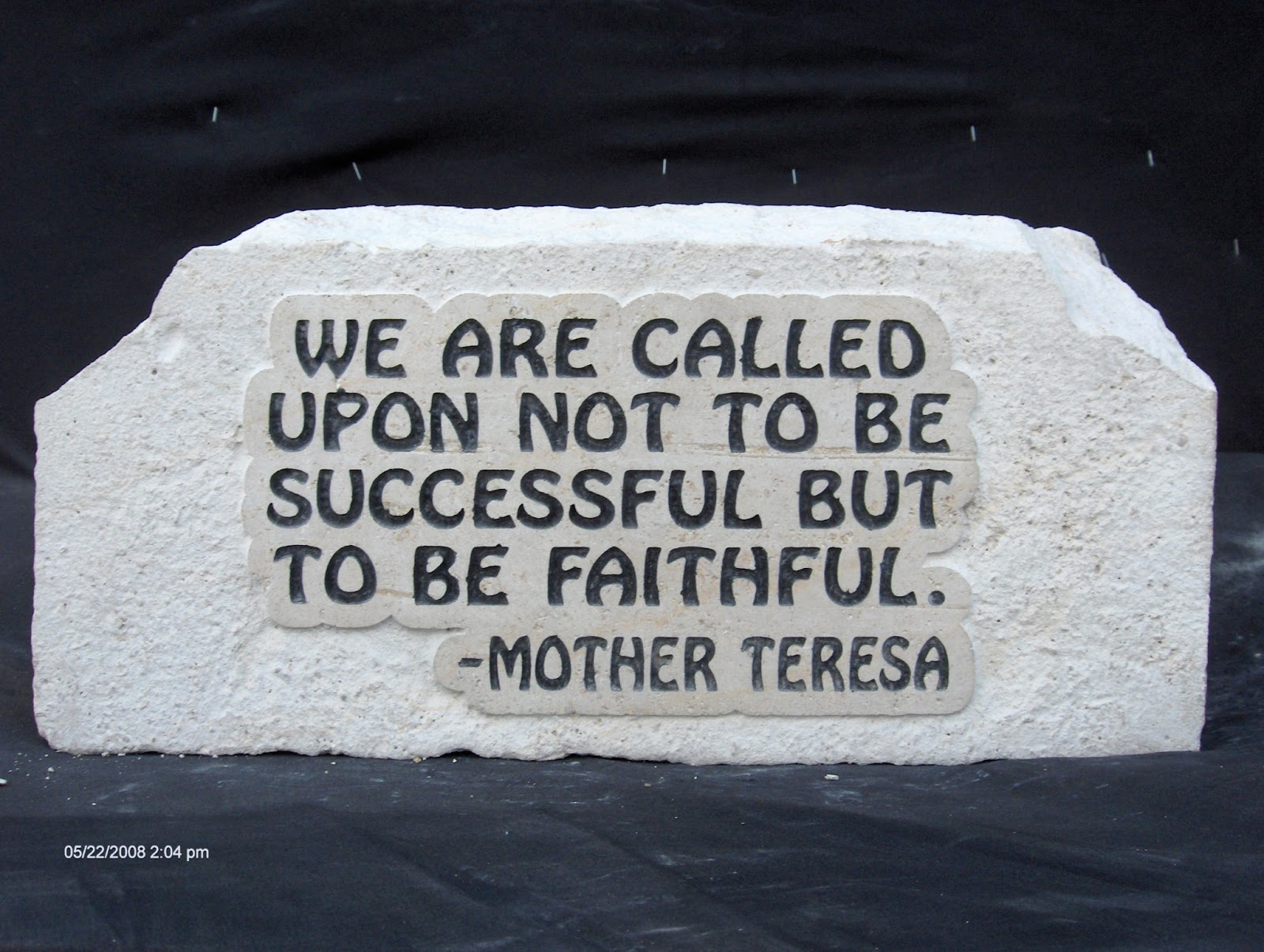
Mark Hatfield (former senator from Oregon) tells of touring Calcutta with Mother Teresa and visiting the so-called “House of Dying,” where sick children are cared for in their last days, and the dispensary, where the poor line up by the hundreds to receive medical attention. Watching Mother Teresa minister to these people, feeding and nursing those left by others to die, Hatfield was overwhelmed by the sheer magnitude of the suffering she and her co-workers face daily. “How can you bear the load without being crushed by it?” he asked. Mother Teresa replied, “My dear Senator, I am not called to be successful, I am called to be faithful.”
The same is true for us – we are called to be faithful not successful.
Have you ever wondered what it means to be a successful Christian?
Is it The mega-church pastor who preaches six times on Sundays, writes chart-topping books, and has his own podcast with really cool rock music at the beginning? Maybe.
Is it the children’s ministry volunteers who patiently work with kids to impact their life for Christ? Maybe.
Is it he homeschooling mom who deals with large volumes of laundry and baby poop on a daily basis? Maybe.
Is it the person who spends lots of hours at the church or home praying for others? Could be.
Is it the youth worker who leads a teen to Christ? Maybe
Is it the follower of Christ who is consistently here on Sunday morning and tithes faithfully? Maybe
In Matthew 25:14-28 Jesus spells out a blueprint for success that’s very different from our standard definitions of success. You know the story. A master is preparing for a journey and starts dishing out the money to his servants.
The first servant gets five bags of silver, the second gets two , and the third gets one (some translations use the word talent). Servants one and two immediately hit the streets, putting their talents to work in the cause of the master. Servant number three digs a hole and buries his talent. The master returns.
Servant number one stands before his master and presents him with ten talents, a return of 100%. Servant number two? One-hundred percent ROI. Servant number three presents the master with a big fat nothing. He simply returns the talent he was given.
The response of the master teacher is incredible. To the first two servants he says:
Well done, good and faithful servant. You have been faithful over a little; I will set you over much. Enter into the joy of your master. “Let’s celebrate together”.
No reference to the numbers. No talk of the bottom line. The master highlights the faithfulness of the servants. You have been faithful over a little. That’s it.
A successful Christian is someone who faithfully uses their talents and circumstances to further the cause of God.
What is the cause of God? To connect people to Christ.
God isn’t interested in producing good results. In fact, if you look at Hebrews 11 you will learn that those who were faithful to God were martyred, abused, and treated poorly for being faithful. But if one is faithful – good things for the Kingdom happen.
What does he say to the two servants who went an invested what he gave them – “Well done good and faithful servant – you have been faithful in little, I will give you more.”
Like the other Fruit of the Spirit we have talked about, no human can produce faithfulness.
How do get faithfulness?
You get faithfulness by putting your confidence in the One who is faithful to you.
Look at God’s faithfulness
22 The faithful love of the Lord never ends!
His mercies never cease.
23 Great is his faithfulness;
his mercies begin afresh each morning.
24 I say to myself, “The Lord is my inheritance;
therefore, I will hope in him!” Lamentations 3
15 But you, O Lord,
are a God of compassion and mercy,
slow to get angry
and filled with unfailing love and faithfulness. (Psalm 86:15)
9 Understand, therefore, that the Lord your God is indeed God. He is the faithful God who keeps his covenant for a thousand generations and lavishes his unfailing love on those who love him and obey his commands. Deuteronomy 7:9
Not that He has to, but, God has proven His faithfulness to His people time and time again throughout history. The scriptures are about (from Genesis to Revelation) God’s love for and faithfulness to His people.
Those who don’t experience His faithfulness don’t stick around long enough to experience his faithfulness. They give up. They quit and then blame God for failing them.
God is always faithful whether we are faithful or not. Look at what Paul says in Rom. 3:3
True, some of them were unfaithful; but just because they were unfaithful, does that mean God will be unfaithful? Romans 3:3
Despite your past – God stayed faithful to you
Despite your personal failures – God has stayed faithful to you
Despite your selfishness – God has stayed faithful to you
Despite the other things we have worshipped – God has stayed has faithful to you.
Despite your moments of unfaithfulness – God has stayed faithful to you.
Despite your disappointment with God – God stayed faithful to you
You can put your confidence in the one who is in the wise control of your life. You can put your confidence in the one who will always remain faithful to you no matter how many times you mess up, no matter how many times you fail, no matter how many times you need forgiveness, no matter how many times you need comfort because it is through those times that you learn what it means to be faithful.
Stop and think about this for a moment.
For those of you have been married for a number of years – think of how faithful your spouse has been to you.
For those of you who have close friends – think of how faithful your friends have been to you.
For those of you who have parents – think of how faithful your parents have been to you.
I am confident that all of us have been disappointed in our spouse
I am confident that all of us have been disappointed in our friends
I am confident that every person who has been a child has been disappointed in their parents.
Why did you stay with them? It is because you thought the relationship was worth fighting for.
I am also confident that every person in this room has disappointed God.
Now think of how faithful He has been to you. Why does He stay with us? Because he believes the relationship is worth dying for!
The only way God can produce faithfulness in you is if you put our confidence in the One who is in wise control of your life and has always been faithful to you.
The third person in this parable had very little confidence in his master.
This third person had a counterfeit faithfulness. He was being loyal out of self-righteous pride.
- The self-righteous are faithful to only themselves and what’s best for them.
- They are not the friend who will be loyal to you through thick and thin. They are in the friendship to drain everything out of you.
- They are unteachable.
- They think they are right all the time.
- They are stubborn.
- They are hard-hearted.
- They worship themselves
- They have no desire to know the truth.
They are faithful out of selfish motives.
A lot of people are in a relationship with Christ for what they can get out of the relationship and not for what they can give to the relationship. We come to worship wanting to get something from God. Over the years I have heard phrases like, “boy, I didn’t get much out of that sermon”, “I didn’t get much out of the songs we sang today”. People are always wanting God to give them something. But God, wants us to give Him something.
What can we give? Our faithfulness.
That is what our best friend wants
That is what our spouse wants
That is what our God wants.
Put your confidence in the ONE who has been faithful to you. He is not expecting big results. Nor is He expecting success.
He simply wants you to stick with Him until your story is over.

Romans 5:3-11
3 We can rejoice, too, when we run into problems and trials, for we know that they help us develop endurance. 4 And endurance develops strength of character, and character strengthens our confident hope of salvation. 5 And this hope will not lead to disappointment. For we know how dearly God loves us, because he has given us the Holy Spirit to fill our hearts with his love.
6 When we were utterly helpless, Christ came at just the right time and died for us sinners. 7 Now, most people would not be willing to die for an upright person, though someone might perhaps be willing to die for a person who is especially good. 8 But God showed his great love for us by sending Christ to die for us while we were still sinners. 9 And since we have been made right in God’s sight by the blood of Christ, he will certainly save us from God’s condemnation. 10 For since our friendship with God was restored by the death of his Son while we were still his enemies, we will certainly be saved through the life of his Son. 11 So now we can rejoice in our wonderful new relationship with God because our Lord Jesus Christ has made us friends of God.
There was once a young boy who went to spend the week with his grandfather on the farm. While walking around he noticed the chickens, they were scratching and playing around. The little lad said, “They ain’t got it”. Next he saw a colt in the field playing and kicking up its heel’s to which he replied, “He ain’t got it”. After examining all of the animals on his grandfather’s farm and see that none of them had “it”, this boy finally found the old donkey in the barn. When he saw the donkey’s long, frowning face and the way that the donkey just stood there he screamed for his grandfather to come quick. “I found it, I found it” the boy kept yelling. When his grandfather asked what he had found he said, “Pawpaw, I found an animal that has the same kind of religion that you have.”
As Christians – we should experts on joy. We should know about joy more than anybody else. I am not talking about the “I love Jesus yes I do, I love Jesus how about you” kind of joy. There are some Christians who are the most miserable people on earth. The words out of their mouth are “I love Jesus, he means more to me than silver or gold,” but their body language, their attitude, and their face say something totally different. I met a lot of these kind of people a couple of decades ago at the camp meeting where I was the youth director. I remember thinking, “you have followed Christ all these years and nothing inside of you has changed?” They had no joy!! All they could do was complain about me, loud music, and focus on everything I was doing wrong.
(A little side note: if you complain all the time, if all you can see is the negative in your situations in life, you need to recommit your life to Christ, be baptized again and start all over)
Joy is the fruit that only God can produce in you. No one can produce joy. Joy comes from being in a relationship with God.
For a Christian, joy is a deep kind of rejoicing – an assurance a security – a mirth. Mirth is a deep seeded gladness. There is a deep seeded gladness that says I have the only thing that really matters. (credit to Tim Keller) I have the assurance and security that no matter what happens in my life – nothing is going to separate me from the love of God. When everything is failing around me. When my life is not going the way I planned. When unfairness comes my way, when disease comes my way, when a lost job comes my way, when stuff happens to me that try to knock me down and out, I have deep seeded gladness.
Troubles are always going to come. Life is always going to throw you curves. Christians are not immune to suffering. Because of the deep seeded gladness (we call joy) we become unsinkable. We might be constantly pushed down but we do not stay down.
Look at what Paul says in 2 Corinthians 4:8
8 We are pressed on every side by troubles, but we are not crushed. We are perplexed, but not driven to despair. 9 We are hunted down, but never abandoned by God. We get knocked down, but we are not destroyed. 10 Through suffering, our bodies continue to share in the death of Jesus so that the life of Jesus may also be seen in our bodies.
Joy makes us unsinkable. We may be pressed on every side by troubles but they cannot crush us.
Joy makes us unsinkable. We are perplexed (or unsure of what is going on in our life) but it cannot drive us to despair.
Joy makes us unsinkable. The world tries to destroy us, but God will never abandon us.
Joy makes us unsinkable. We get knocked down by disappointment and uncertainty, but it will not destroy us.
Joy makes us unsinkable. Suffering is going to find us but we know it only last for the moment.
Romans 5 tells us to rejoice when we run into problems and trials because we know deep in our heart that they will help us develop endurance. Endurance develops character, character strengthens our confidence in God. Paul is not telling us we have to be happy about it. Paul doesn’t tell us to put on a happy face and say everything is ok. Paul doesn’t say to fake your way through the pain, sorrow, trials, and perplexities of life. There is a difference in joy and happiness. The Bible never teaches us to fake happiness and put on a religious show when things happen to us.
Happiness comes from the comfort of having the things that you want. Happiness happens when we have our comforts and things are going our way. Happiness is a counterfeit joy. Many think it is joy but it is not. Think of it this way, when a child gets what he/she wants they are happy. When you take away that thing that is bringing the happiness the child throws a fit.
Joy is a deep kind of rejoicing. When unhappy moments come in our life we can fall back on something deeper. That something deeper is the deep gladness in knowing (in my heart, mind, and soul) that I put my confidence in the God who is in control of my life.
I met with Nathan Harmon this week. This is the young man who spoke at our Championship Sunday a few weeks ago. I asked him, “ what does joy look like?” He didn’t have words to describe it? He simply did this:
He basically said he had an unspeakable joy. He went onto say that you can’t explain it. I prodded him on. He finally said, “I know when things come my way and try to discourage me – I know that Christ is in me – he is not going to leave me or forsake me. I know my creditors are going to call. I know things are going to happen in my life that will try to take me down. The joy I have comes from having a deep seeded relationship with Jesus. I understand how much he loves me now.”
Joy comes when you put your confidence in the one who is in wise control of your life. Our confidence is not in the health of our bodies, it is not in the security of our jobs, it is not in our bank accounts – our confidence is in the hope of salvation. This kind of hope will not lead to disappointment. Because I am saved and I know Christ, I am confident that God is in control. Knowing that he is in control I have a deep seeded gladness that will not let me stay down.
In other words, we might constantly be being pushed down but we don’t stay down. We have a spiritual buoyancy that comes from focusing on the unchanging privileges we have in God.
- We have the privilege of forgiveness
- We have the privilege of mercy
- We have the privilege of compassion
Joy comes from focusing on the Blesser and not the blessing.
CS. Lewis says this, “Our Lord finds our desires not too strong, but too weak. We are half-hearted creatures, fooling about with drink and sex and ambition, when infinite joy is offered to us, like an ignorant child who wants to go on making mud pies in the slum because he cannot imagine what is meant by the offer of a holiday at the sea. We are far too easily pleased.”
Happiness is resting in the blessing and not the Blesser.
Joy is resting in the Blesser and not the blessing.
There is nothing wrong with the blessing and the pleasures we enjoy. What is wrong is what we put our focus on. My in-laws have been extremely generous to my family. They have taken us places I have only dreamed of going. Initially I felt guilty. But when I realized it was a tremendous gift from God, I began thanking and praising Him for the beautiful gift.
Look at what David says in Psalm 4:7
You have given me greater joy
than those who have abundant harvests of grain and new wine.
Do you hear what David is saying? They only have joy when the harvest is good. To put in modern-day terms, they only have joy when the stock market is up and I have joy all the time. Their joy is in the stock market. My joy is in the one who owns all the wealth in the world and is going to give me everything I need.
David is focused on the Blesser!
When you are focused on the Blesser, you understand the blessings and understand their place in you’re your life. The blessings you have and the pleasures you experience are just a tiny sample, or as Tim Keller puts it, a “DIM HINT”, of the joy of the Lord.
The deep seeded gladness of knowing the Blesser is in control of your life. You don’t live for the blessing – you live for the BLESSER.
I was tempted last night to simply read this poem as the message today. It sums up well everything that has been said. If you would like a copy of it I will need to get permission from her if it is okay to share with you. This was written by a 16-year-old girl who I have the pleasure of knowing. Her life was touched by some bad news this past week. Listen to her response to the bad news she received this week:
She wrote a poem – It is called LIFT
Lift
Bad things happen
So they say
But in my world
they are a fantasy.
A fantasy I try to forget
A fantasy that’s not real
Hasn’t happened
Never will.
Then it becomes real
My heart sinks
Like boulder in the ocean
All the way down
To the tips of my toes
Making it hard
To lift my lips to smile
To lift my feet to walk
To lift my head to see.
Tears flow like a river
They try to lift the boulder.
Sometimes it does
Other times it doesn’t.
When will it go away?
When will it end?
With my head weighted down
I do the only thing I know to do.
When I can’t lift my lips to smile
When I can’t lift my feet to walk
When I can’t lift my head to see
I pray.
Jesus fills my soul
With an ocean of joy
Smashes the boulder
Takes it away.
I am overflowing joy.
I can lift my lips to smile
I can lift my feet to walk
I can lift my head to see.
Lifting is no longer a burden.
It is forever gone.

Where does peace come from?
The obvious answer is from God. It is one of the fruit of the Spirit. (Galatians 5) We can’t create it. We can’t buy it! You can’t sell it! it cannot be manufactured by man in any sustainable way. It only comes from God.
Harotio Spafford experienced this kind of peace. He was a lawyer who wrote one of the most sung hymns around the world at the spot where his children were killed in a ship accident that sunk the ship they were on. He wrote the hymn, “It is Well With My Soul”. Previous to all this he lost his business to the Chicago Fire. According to the world’s standards he lost everything.
Where does this kind of peace come from? It come from having a relationship with God.
Take a look at today’s scripture: Philippians 4:6-9
6 Don’t worry about anything; instead, pray about everything. Tell God what you need, and thank him for all he has done. 7 Then you will experience God’s peace, which exceeds anything we can understand. His peace will guard your hearts and minds as you live in Christ Jesus.
8 And now, dear brothers and sisters, one final thing. Fix your thoughts on what is true, and honorable, and right, and pure, and lovely, and admirable. Think about things that are excellent and worthy of praise. 9 Keep putting into practice all you learned and received from me—everything you heard from me and saw me doing. Then the God of peace will be with you.
Tim Keller defines peace as a – Confidence and trust in God’s wise control of your life.
In other words you are confident that God is in control. Think about the things you are confident in. There is a peace. You have confidence that you can do it. The things we are less confident in we worry about.
Peace has to deal with the confidence YOU have that God is in control of your life. He has confidence in you.
There is a lot of evidence throughout the scripture that helps us understand that God is in control of everything.
Hebrews 1:3
3 The Son radiates God’s own glory and expresses the very character of God, and he sustains everything by the mighty power of his command. When he had cleansed us from our sins, he sat down in the place of honor at the right hand of the majestic God in heaven.
Colossians 1:16-18
16 for through him God created everything
in the heavenly realms and on earth.
He made the things we can see
and the things we can’t see—
such as thrones, kingdoms, rulers, and authorities in the unseen world.
Everything was created through him and for him.
17 He existed before anything else,
and he holds all creation together.
18 Christ is also the head of the church,
which is his body.
He is the beginning,
supreme over all who rise from the dead.
So he is first in everything.
Isaiah 40:28-31
Have you never heard?
Have you never understood?
The Lord is the everlasting God, the Creator of all the earth.
He never grows weak or weary.
No one can measure the depths of his understanding. He gives power to the weak
and strength to the powerless.
30 Even youths will become weak and tired,
and young men will fall in exhaustion. But those who trust in the Lord will find new strength.
They will soar high on wings like eagles.
They will run and not grow weary.
They will walk and not faint.
Peace comes from having the confidence that God is in control.
The opposite of peace is anxiety and worry. If you are anxious and worried a lot you don’t have very much confidence in God.
Philippians 4 tells if you are anxious and worried pray about it and tell God what you need. All of your request need to be presented with thanksgiving. Then you will experience peace.
He tells us to thank him when you make the request because you are saying to God, “whatever you do in response to this request is good.” Whether you answer me or not – I am going to give you thanks because you know what is best for me. The way YOU answer is good. God sees your life – God knows your heart – He knows your need.
Thank Him for the things that don’t go the way you plan them. We have a tendency to thank him only when we get our desire our need met. When was the last time you thanked for the miserable times in your life? When was the last you thanked for not answering your prayer you wanted it answered?
If He doesn’t meet your need – thank Him
If He doesn’t heal your body – thank Him
Pray with this attitude – “God I have confidence in the fact that you know what you are doing! So, I am going to thank-you for the way you answer because I know you see the bigger picture, I know you are in control. I know you understand what is good for me.”
Peace comes from the confidence of knowing God is in control.
The perfect time to come to God is when your life is out of control. Because he will give the peace you are longing for. God knows when your life is out of control. It is no surprise to Him. When you life is out of control you find yourself running to different things to gain control of your life. We run to sex, alcohol, material things, sports, or become a workaholic. We run to the first thing that gives us a peaceful feeling. In reality it doesn’t give us peace – it just gives us relief. It is like how an aspirin/ibuprofen brings some relief to a headache. It just brings relief to a symptom.
Tim Keller tells us that we can develop a counterfeit of peace which is called cynicism. We say or think things like, “there is nobody around who knows better than me and I don’t even know and nobody really knows.” There is a cynicism and an apathy that leads to a hardening of your own heart so that you don’t care and it can look like you have peace.
The way you can tell the counterfeit from the real thing is by those who have a fruit of the Spirit called peace are also tender-hearted and loving, they have self-control and patience, they are also gentle and compassionate. They are humble and you sense a genuineness in their spirit. Those who have manufactured peace or a counterfeit peace have a peace that exist by itself. A person who manufactures peace is not tender-hearted and not loving and not approachable and not humble.
Jonathan Edwards in his book “Religious Affection” says the only way you can really be sure that a person’s love, joy, peace, patience, kindness, gentleness, and self-control is not counterfeit is that it happens all together. There is a symmetry about them. They grow together and only the Spirit of God can only create them together. We don’t develop them right away. They all grow together.
When we have confidence (an assurance, a trust) that God is in control there is a peace that passes all understanding. You can’t explain it. No pastor can explain it. It is something only a relationship with God can produce in you.
Look at the life of Jesus
1) He was rejected and despised of men.
2) He was cruelly beaten and crucified.
Then He voluntarily crawls on the cross to die for our sins.
Jesus had a confidence and a trust that His Father was going to raise Him on the 3rd day. If you think about it He was only going on what his Father told Him. He had confidence that God would keep his promise to raise him on the 3rd day.
He wasn’t bitter, he wasn’t selfish. He was kind. He was gentle. He was loving. He was patient. He had self control. In fact he controlled the whole thing. He voluntarily obeyed his Father. He didn’t have to – he volunteered to.
Look at the life of Joseph
- He was left for dead
- He was sold into slavery
- He was accused of rape
- He was thrown in jail
But in the end he tells his brothers, “What you intended for evil, God turned it into something good.” Joseph demonstrates how the Fruit of the Spirit work together.
Real peace is having a confidence and assurance that God is in control of your life.
- We may not like our life.
- We may not agree with God that this it the way our life should go.
But we trust Him. We put our confidence in Him – knowing that everything that is happening in my life right now – he is going to weave it all together and make our life a beautiful tapestry.
If you want peace in your life, he says, “Don’t worry about anything. Instead pray about everything. Tell God what you need and thank Him His answer. If you want peace in your life, “fix your thoughts on what is true, and honorable, and right, and pure, and lovely, and admirable. Think about things that are excellent and worthy of praise. 9 Keep putting into practice all you learned and received from me—everything you heard from me and saw me doing. Then the God of peace will be with you.”
If you want peace in your life – STOP and THINK!
When my kids were little and they did something stupid, I would tell them, “use the cotton-picking brain God gave you.”
Tim Keller goes on to say if you are worried and anxious – you are not thinking. He’s right. Worrying is the absent of thought. It affects our heart. Who continues on to say (when you are anxious and/or worried) that you can either listen to your heart or talk to your heart.
On Monday we go to our regular routine and regular stresses plus unexpected stresses that we can’t plan for. We go back to thinking, “what am I going to do about this, what am I going to do about that.” And the tail spin starts all over.
Is Psalm 42 – David is depressed what does David do – he talks to his heart. Listen to what he says in verse 5
Why am I discouraged?
Why is my heart so sad?
I will put my hope in God!
I will praise him again—
my Savior and 6 my God!
David is talking to HIS HEART. Instead of listening to his heart and getting more depressed – he is talking to it. He is telling his heart – think about this and think about this. Think about the one who made the things we can and cannot see. Think about the one who existed before anyone else. Don’t forget who it is that save you.
THINK!
Worry is listening to your heart. Peace comes from talking to your heart about who you are in Christ.
Whenever you get worried – THINK and talk to your heart about your relationship with Him
Whenever you get anxious – THINK and talk to your heart about your relationship with Him.
Because in the end – that is all that really matters – right?
 Click on this image and you can see our Jamaica Mission Team in action. This past Sunday the team that went from our church to Jamaica shared their experience of what God did in us and through us. When you go on a trip like this your intentions are to go and bless others who don’t have as much as you. What always happens (you have to go on a trip to understand the statement that follows) you are the one who leaves blessed. It is more than feeling good about yourself for doing what we should be doing anyway, it is an experience that changes the way you think about God, yourself, and serving others. I am going to share some of the highlights from what some our mission team shared from Sunday. From their responses, you will get a glimpse of the impact this experience had on them.
Dana, Lyndsay, and Kaleigh shared how the impacted their life. The highlight of their sharing was God is faithful. Our Father gave us a safe flight, took care of all our fears, and provided everything we needed. A specific highlight from the testimonies was Kaleigh sharing about how she wishes she had a second chance at going to the infirmary. The infirmary was an overwhelming experience. All of the outcast are put here and forgotten about by their families. If you have a mental illness, you go here. If you have deformity, you go here. If you have a missing limb, you go here. If you can’t take care of yourself, you go here. Some people would call this infirmary a nursing home. It definitely was not a nursing home. One room had at least 40 beds in it. There were some rooms that were like locked cages. These cages were where the dangerous patients stayed. They put them in there so they wouldn’t hurt anybody. As Kaleigh shared (and the rest agreed with her), she realized she missed an opportunity to love another human being. The experience was a growing experience for all of us. We all realized after we left that place that everyone deserves to be loved. Everyone deserves to be called by their name. Everyone deserves to be prayed for.
The first question that was asked was:
What did you learn about, the people, the church, and Christian community in which you served?
Us, “whities” (pronounced “why – tees”), were received well. The church loved on us. The community welcomed us. We were the minority. We were not treated like a minority. Other than “whities”, we were called missionaries. Missionaries (at least us) are treated well in Jamaica. We learned that God is at work through the church in Jamaica. The church we were apart of is very similar to our church here in Marion, IN. We have a few more “niceties” than they do but they have better scenery. Our worship was similar. The big difference was the amount of time we spent in worship. We were at church for 2.5 hours. Our desires are similar. We both want to impact people for Christ.
The second question asked was:
What did you learn or experience that will change the way you live and represent Jesus in our own community?
Lyndsay shared an impactful story. When she got back from Jamaica she went back to work at a job she hates. She shared that she was treating the customers poorly. Her boss, who is in ministry, pulled her into his office. What he shared with her impacted her attitude. Her boss reminded her, “‘we are serving the least of these’ here in America. You need to have the same attitude with these people as you had with the people in Jamaica. You need to treat them with respect. You need to love them. You need to accept them where they are and serve them here in your job.” First of all, WHAT A BOSS! That doesn’t happen very often. Lyndsay learned we need to have the same attitude here with “the least of these” as we do with the people in Jamaica (or any country). We need to serve others at our jobs with and in the attitude of Christ. It doesn’t make a difference what country they live in – serve them.
The third question asked was:
What difference would it make if you lived each day with the same intensity and focus on Jesus and others as you did on your mission?
Everyone agreed it would change the world in which we lived. Everyone agreed it would change us personally. Kelsi, who has also been to Africa to serve as a medical missionary, shared that anything you for “the least of these” will impact their life. What we take for granted, God uses to impact their life. We came to the conclusion that we live in a very selfish country. We take most of what we have with the attitude that we are entitled to it. If we lived each day with the same intensity and focused on Jesus and others we would be doing exactly what the gospel instructs us to do. Go and serve others.
The last question asked was:
What keeps us from living life at that level now?
I think Tim nailed it on the head, SELFISHNESS! Tim shared a story from when he was going through customs. As he was standing in line there was a guy from Tennessee who was constantly complaining how long the line was. He pulled out his cell phone to check his Facebook account only to be told to put it away (when you are going through customs you cannot have your cell phone out for any reason). He continued to complain about the inconvenience of the long lines and the inconvenience of not being able to use his cell phone in a loud and annoying fashion. Patrick (our group leader) look at Tim and said, “welcome back to America.”
We, as a church, are working at getting at “that level.” When we got back from Jamaica, our church hosted a block party for about 150 people around the 28th st. park. We had 8 people knock on about 400 doors. We had 30 people show up and give their Saturday evening to serve 150 guest. WOW! I wept. We did exactly what we did in Jamaica. We got out of our comfort zone. Introduced ourselves to the community. Hopefully we will be able to connect some of them to Christ.
We have been to Jamaica. We have hosted a block party. We need to do this on a personal level.
Look a Matthew 9
9 As Jesus was walking along, he saw a man named Matthew sitting at his tax collector’s booth. “Follow me and be my disciple,” Jesus said to him. So Matthew got up and followed him.
10 Later, Matthew invited Jesus and his disciples to his home as dinner guests, along with many tax collectors and other disreputable sinners. 11 But when the Pharisees saw this, they asked his disciples, “Why does your teacher eat with such scum?”
12 When Jesus heard this, he said, “Healthy people don’t need a doctor—sick people do.” 13 Then he added, “Now go and learn the meaning of this Scripture: ‘I want you to show mercy, not offer sacrifices.’ For I have come to call not those who think they are righteous, but those who know they are sinners.”
Do you see what Matthew did? He invited Jesus, his new disciple friends to come as his dinner guest at HIS HOME along with many tax collectors and disreputable sinners. Do you see it yet? He invited sinners AND his disciple friends to eat together!!! He wanted his friends (who were sinners) to meet his new friends (who were disciples of Jesus). All he did was invite them to dinner. Nowhere in scripture does it tell what happened during the dinner. I have an idea. Whenever you meet Jesus, personally, you are changed. You either reject him or accept him.
We can do the exact same thing. We all know people who don’t know Jesus. Our job is to introduce them to Him. All we have to do is invite them over for dinner and play a few games. Then, let the discussion flow. They will either reject Him or accept Him.
Connect with Others
Connect them to Christ
(so that) He can transform their life.
 Meet Nathan Harmon. I met Nathan at the Pregnancy Help Center’s walk for life early in the month of June. When I met him I didn’t realize he was fresh out of prison on charges of vehicular homicide. A couple weeks later we were able to get together and he told me the rest of his story. Nathan’s story is a story of God’s transforming power. Not only was Nathan’s life transformed by the grace of God, but you get to hear a story of a family who lost a daughter, a mother, sister, and an aunt. They showed AMAZING GRACE to this young man. This AMAZING GRACE changed his life. As you listen to his story (just click on his image), you will hear Nathan share how God has transformed his life. Nathan has spoken at Ball State University, Indiana University, the Juvenile Detention Center in Marion, IN, and of course here at the First Church of God in Marion, IN.
We also honored our “star athletes” from our soccer and volleyball camps last week. Just click on the picture below and you will get to see these star athletes in action. 

There is the story of the little boy who used to escape his bedroom after being punished. He would crawl out of his bedroom window down an old fruit tree to the ground. One day his father told him he was going to chop down the fruit tree because it hadn’t borne any fruit for a number of years.
That evening, the boy and his friend bought a bushel of apples, and during the night he tied those apples on the barren branches. The next morning , the man could not believe his eyes. He said to his wife, “Honey, I just can’t believe it! That old tree hasn’t yielded any fruit for years, and now it is covered in apples. And, the most amazing thing is that it’s a pear tree. “
Our scripture is Galatians 5:22-23 (NLT)
22 But the Holy Spirit produces this kind of fruit in our lives: love, joy, peace, patience, kindness, goodness, faithfulness, 23 gentleness, and self-control. There is no law against these thing!
The first thing to understand is:
- Only the HOLY SPIRIT can produce this kind of fruit.
As we learned over the past couple of months we can pretend to do these things
- We can pretend to love others
- We can pretend to have joy
- We can pretend to have patience
- We can pretend to be good
- We can pretend to be faithful
- We can pretend to be gentle
- We can pretend to have self-control.
The reality is only the HOLY SPIRIT can produce this fruit in our lives. No amount of human energy can produce this kind of fruit. You can try all you want. And keep trying all you want. The scriptures teach us we will always fall short. We can produce, cars, cell phones, and many other things. But we cannot produce only what God can produce.
I am convinced that God is not concerned about what we produce in this life. He says it is all filthy rags. If you remember from a few weeks ago Paul says they are all garbage compared to knowing Christ.
We want to produce:
- Good careers
- Good life
- Good children
- Good behaviors
- Good money
There is nothing wrong with any of those. As I read the scriptures, I am learning that God is not concerned with producing those things. Sinners and saints alike can produce those things. God wants to produce love, joy, peace, patience, kindness, goodness, faithfulness, gentleness, and self-control. These things are what are important to Him.
How many of you have ever prayed for more patience? Have you ever wondered why you never get it? We usually pray, “Lord, give me patience; and give it to me right now!” We want it right now! I think we know this but It can’t happen, “right now!”
It can only be produced in you by the HOLY SPIRIT.
Children bring out the best and the worst in us. Having 5 kids – each one of them has helped me realize where I fall short. Each one of them has put me to the test. They have an uncanny way of bringing to the surface, areas that I need the Holy Spirit to produce in me. They also help me realize that we can’t produce this kind of fruit.
I have also learned that you can’t compartmentalize the fruit of the Spirit – they all work together. We can just say that I am going to work on patience today or that I am going to just work on gentleness today.
We pray for patience as if it is separated from the rest. They are all intertwined. Take notice that it is the fruit of the spirit – Not fruits. They are all intertwined. Each one of them effects the others. They work together.
God wants to produce the fruit of the Spirit in us. It all goes together. Each one affects the other. Producing fruit takes time. Just look at the amazing garden here at the church. Each seed has to die to produce fruit.
It has to be planted, watered, weeded, and picked. Wouldn’t it be nice if you could plant a garden and the next day – you had fresh fruit and vegetables. They haven’t yet figured out how to microwave a garden. It takes time to grow a garden. It takes a master gardener to weed stuff out of lives that steal our energy. It takes a Master Gardener to watch over plant and give that plant it needs to produce fruit.
It takes time and energy.
When you try to ripen fruit quickly, it loses it flavor. In America, tomatoes are usually picked unripened so they won’t bruise during shipping. Then, before they are sold, these green tomato are sprayed with C02 gas to turn them red instantly. The outside of the tomato looks red, but when you bite into it – it taste green.
Do you see the spiritual parallel? We try to rush the work of the Holy Spirit in our lives. We take spiritual shortcuts. We use spiritual C02. We think God works in our timing and goes at our pace, thus, we never grow up.
I met an older gentleman as I was walking around knocking on doors this past week. He had a nice collection of cars in his garage. He had an old BMW roadster, corvette and an old John Deere, antique tractor. As I was talking to him. He asked me, “pastor let me show you something. There is something I don’t understand – I have the cross all around my house – he showed me all the crosses around the outside of his house. He even had a lighted cross in his window. After he showed me all the crosses around the house, he asked, “With all these crosses around my house – why do people break in and steal my stuff?” I promptly answered, “I don’t know.” As I listened to his story, this man has never spiritually grown up. The cross to him was a magic wand. It was like a lucky rabbits foot.
I met another guy with cancer. Living alone. He had just gone through chemotherapy and was pretty weak. I listened to his story. At the end of our conversation I offered to pray for him. He said, “sure, but God hasn’t been very good to me.” I simply reminded him that God was with him.
I met another guy, who sat me down gave me a hot dog and some water and asked me how was I doing.
What I liked about this second guy is that he was honest with me. God had disappointed him. God hadn’t healed him. In fact, according to Him, God hadn’t done anything to show Him that He loved him. He was wondering where God was at. The third guy was Jesus to me.
Forgive me for judging – but I believe I will see the second/third guy in heaven someday. I am not so sure about the first.
There are no short cuts to growing up! Some people refuse to grow up. They look mature but their life is shallow. We look at them and say ‘why don’t they just grow up!
I am pretty sure God says the same thing to us. Look at the nation of Israel – they had seen miracle after miracle, after miracle. And they still couldn’t obey. Many of them refused to grow up and be God’s chosen people. And it feels like we are still doing the same thing today.
We refuse to let the Holy Spirit get rid of the weeds, the dead branches in our lives. These things steal our energy They kill us spiritually. Things that are just draining and stunting our growth.
John 15:1-2
I am the true vine, and my Father is the gardener. 2 He cuts off every branch in the me that bears no fruit, while every branch that does bear fruit he prunes so that it will be even more fruitful.
The fruit John is speaking about is not good works. The fruit John is speaking about is not good results. The fruit John is speaking about is the fruit of spirit.
Pruning is painful. Pruning hurts. Pruning produces a mature life.
- Every obstacle that comes our way in life is an opportunity for God to prune our childishness out.
- Every trial that comes our way in life is to teach us what in life is really important.
- Every pain that comes our way in life is to prepare us to become more fruitful.
The story you are about to hear is a story about a young man who has allowed the Holy Spirit to do some pruning in his life. As you listen to his story, listen to how God can transform the “goodest” of people into a devout follower of Christ. This is just the beginning of Matt’s journey. Click here to hear his story.
 mondayschoolblog